Early Rock Art From Africa May Be as Old as
 Rhino drawings from the Chauvet Cavern, 37,000 to 33,500 years old | |
| Catamenia | Stone Historic period |
|---|---|
| Dates | 50,000 to 12,000 BP |
| Preceded past | Middle Paleolithic |
| Followed by | Mesolithic |

The Upper Paleolithic (or Upper Palaeolithic) likewise chosen the Late Stone Age is the 3rd and last subdivision of the Paleolithic or One-time Stone Age. Very broadly, it dates to between 50,000 and 12,000 years ago (the beginning of the Holocene), according to some theories coinciding with the appearance of behavioral modernity in early modern humans, until the advent of the Neolithic Revolution and agriculture.
Anatomically modernistic humans (i.e. Homo sapiens) are believed to have emerged in Africa around 300,000 years agone, although it has been argued by some that their ways of life changed relatively little from that of primitive humans of the Eye Paleolithic,[one] until virtually 50,000 years agone, when there was a marked increment in the diversity of artefacts plant associated with modern man remains. This period coincides with the about common date assigned to expansion of mod humans from Africa throughout Asia and Eurasia, which contributed to the extinction of the Neanderthals.
The Upper Paleolithic has the primeval known evidence of organized settlements, in the class of campsites, some with storage pits. Artistic work blossomed, with cavern painting, petroglyphs, carvings and engravings on bone or ivory. The first evidence of human fishing is also found, from artefacts in places such equally Blombos cave in Southward Africa. More complex social groupings emerged, supported by more varied and reliable food sources and specialized tool types. This probably contributed to increasing grouping identification or ethnicity.[ii]
The peopling of Commonwealth of australia most probable took place earlier c. 60 ka. Europe was peopled after c. 45 ka. Anatomically modern humans are known to take expanded northward into Siberia as far as the 58th parallel past about 45 ka (Ust'-Ishim homo). The Upper Paleolithic is divided by the Last Glacial Maximum (LGM), during virtually 25 to 15 ka. The peopling of the Americas occurred during this fourth dimension, with Eastward and Central Asia populations reaching the Bering land bridge after about 35 ka, and expanding into the Americas by near fifteen ka. In Western Eurasia, the Paleolithic eases into the so-called Epipaleolithic or Mesolithic from the finish of the LGM, beginning xv ka. The Holocene glacial retreat begins eleven.7 ka (10th millennium BC), falling well into the Old World Epipaleolithic, and marker the beginning of the earliest forms of farming in the Fertile Crescent.
Lifestyle and technology [edit]
Both Homo erectus and Neanderthals used the same crude stone tools. Archeologist Richard G. Klein, who has worked extensively on ancient stone tools, describes the stone tool kit of archaic hominids equally impossible to categorize. He argues that almost everywhere, whether Asia, Africa or Europe, earlier 50,000 years ago all the stone tools are much alike and unsophisticated.
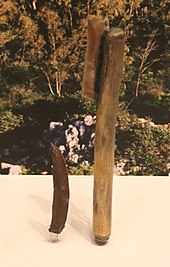
Firstly among the artefacts of Africa, archeologists found they could differentiate and classify those of less than 50,000 years into many different categories, such every bit projectile points, engraving tools, knife blades, and drilling and piercing tools. These new stone-tool types have been described as being distinctly differentiated from each other; each tool had a specific purpose. The early mod humans who expanded into Europe, usually referred to as the Cro-Magnons, left many sophisticated stone tools, carved and engraved pieces on bone, ivory and antler, cave paintings and Venus figurines.[3] [4] [5]
The Neanderthals continued to apply Mousterian rock tool technology and possibly Châtelperronian engineering. These tools disappeared from the archeological record at around the same time the Neanderthals themselves disappeared from the fossil record, about 40,000 cal BP.[half-dozen]

Stone core for making fine blades, Boqer Tachtit, Negev, Israel, circa 40,000 BP.
Settlements were often located in narrow valley bottoms, mayhap associated with hunting of passing herds of animals. Some of them may have been occupied yr round, though more commonly they appear to accept been used seasonally; people moved between the sites to exploit unlike food sources at different times of the year. Hunting was important, and caribou/wild reindeer "may well exist the species of unmarried greatest importance in the entire anthropological literature on hunting."[7]
Technological advances included significant developments in flint tool manufacturing, with industries based on fine blades rather than simpler and shorter flakes. Burins and racloirs were used to piece of work bone, antler and hides. Avant-garde darts and harpoons also announced in this menstruation, along with the fish hook, the oil lamp, rope, and the eyed needle. Line-fishing of pelagic fish species and navigating the open up sea is evidenced by sites from Timor and Buka (Solomon Islands).
The changes in human behavior have been attributed to changes in climate, encompassing a number of global temperature drops. These led to a worsening of the already biting common cold of the last glacial period (popularly simply incorrectly chosen the last water ice historic period). Such changes may have reduced the supply of usable timber and forced people to look at other materials. In add-on, flint becomes brittle at low temperatures and may not have functioned equally a tool.
Changes in climate and geography [edit]

The climate of the menses in Europe saw dramatic changes, and included the Terminal Glacial Maximum, the coldest phase of the last glacial period, which lasted from about 26.5 to 19 kya, beingness coldest at the end, before a relatively rapid warming (all dates vary somewhat for unlike areas, and in different studies). During the Maximum, most of Northern Europe was covered past an ice-sheet, forcing human being populations into the areas known as Terminal Glacial Maximum refugia, including mod Italia and the Balkans, parts of the Iberian Peninsula and areas around the Black Sea.
This period saw cultures such as the Solutrean in France and Kingdom of spain. Homo life may have continued on superlative of the water ice sheet, simply we know next to cypher about information technology, and very little about the human life that preceded the European glaciers. In the early part of the menses, upwards to about 30 kya, the Mousterian Pluvial made northern Africa, including the Sahara, well-watered and with lower temperatures than today; afterward the end of the Pluvial the Sahara became arid.

The Last Glacial Maximum was followed by the Allerød oscillation, a warm and moist global interstadial that occurred around 13.5 to 13.eight kya. Then at that place was a very rapid onset, possibly inside as little as a decade, of the cold and dry Younger Dryas climate period, giving sub-arctic weather condition to much of northern Europe. The Preboreal ascent in temperatures also began sharply around 10.3 kya, and by its terminate effectually 9.0 kya had brought temperatures nearly to present day levels, although the climate was wetter.[ commendation needed ] This catamenia saw the Upper Paleolithic give manner to the start of the following Mesolithic cultural period.
As the glaciers receded bounding main levels rose; the English Channel, Irish Sea and Due north Sea were land at this time, and the Blackness Sea a fresh-h2o lake. In particular the Atlantic coastline was initially far out to body of water in modern terms in most areas, though the Mediterranean coastline has retreated far less, except in the north of the Adriatic and the Aegean. The ascension in body of water levels continued until at least vii.5 kya (5500 BC), then evidence of human activity forth Europe's coasts in the Upper Paleolithic is mostly lost, though some traces have been recovered by fishing boats and marine archaeology, especially from Doggerland, the lost area beneath the Due north Sea.[ citation needed ]
Timeline [edit]
50,000–40,000 BP [edit]

Anatomically Modern Humans known archaeological remains in Europe and Africa, direct dated, calibrated carbon dates as of 2013.[8]

l,000 BP
- Numerous Ancient stone tools were found in gravel sediments in Castlereagh, Sydney, Australia. At start when these results were new they were controversial; more recently dating of the same strata has revised and corroborated these dates.[10] [11]
- Start of the Mousterian Pluvial in Due north Africa.
- Occupants of the Fa-Hien Lena cave, Sri Lanka had adult bow and arrow technology 48,000 BP (though the primeval known bow and pointer technology dates to nearly 65,000 BP from Sibudu Cavern, South Africa[12] [thirteen] [xiv] [15]).
45,000–43,000 BP
- Earliest evidence of modern humans institute in Europe, in Southern Italy.[16] These are indirectly dated.[17]
- Earliest mathematical antiquity, the notched Lebombo os, a possible tally stick or lunar agenda, dated to 44,000–43,000 BP in Eswatini (Swaziland), southern Africa[eighteen]
- Oldest-known mining in archaeological record, the Ngwenya Mine in Swaziland, at near 43,000 years ago, where humans mined hematite to make the red paint ochre[19] [xx]
- Earliest directly dated figurative cave fine art of mankind at Leang Bulu' Sipong on Sulawesi, Indonesia.
43,000–41,000 BP
- Ornaments and skeletal remains of modern humans, at Ksar Akil in Lebanon. These are direct dated.[17]
- Denisova hominins live in the Altai Mountains (Russia, Communist china, Mongolia, and Kazakhstan)
40,000–thirty,000 BP [edit]
forty,000–35,000 BP
- First human inhabitants in Perth, Australia, equally evidenced by archaeological findings on the Upper Swan River.[21]
- During this time period, Melbourne, Australia was occupied by hunter-gatherers.[22] [23]
- Early cultural centre in the Swabian Alps, oldest depiction of a human being (Venus of Hohle Fels), beginning of the Aurignacian.
- Löwenmensch figure created in Hohlenstein-Stadel, one of the primeval figurative art. It is at present in Ulmer Museum, Ulm, Germany.
- The first flutes appear in Federal republic of germany.
- Most of the giant vertebrates and megafauna in Australia became extinct.
- Angling of pelagic fish species at Jerimalai shelter, Timor.

- Examples of cave art in Espana are dated from around 40,000 BP, making them the oldest examples of cavern art yet discovered in Europe (run across: Caves of Nerja). Scientists theorise that the paintings may have been made by Neanderthals, rather than by homo sapiens. (BBC) (Science)
- Wall painting with horses, rhinoceroses and aurochs is made at Chauvet Cave, Vallon-Pont-d'Arc, Ardéche gorge, French republic. Discovered in Dec 1994.
- Bear witness for continued Neanderthal presence in the Iberian Peninsula at 37,000 years ago was published in 2017.[24]
- Archaeological studies support human being presence in the Chek Lap Kok area (now Hong Kong International Airport) from 35,000 to 39,000 years ago.[25]
- Zar, Yataghyeri, Damjili and Taghlar caves in Azerbaijan.
- Get-go evidence of people inhabiting Japan.[26]
35,000 BP
- Kostenki XVII, a layer of the Kostenki (Kostyonki) site, on the eye Don River, was occupied by the early upper paleolithic Spitsyn civilization.
xxx,000 BP
- Beginning basis rock tools appear in Japan.[27]
- End of the Mousterian Pluvial in North Africa.
- The area of Sydney was occupied by Aboriginal Australians during this time period, as evidenced by radiocarbon dating.[28] In an archaeological dig in Parramatta, Western Sydney, information technology was found that the Aboriginals used charcoal, stone tools and possible aboriginal campfires.[29]
- Start human settlement in Alice Springs, Northern Territory, Australia.[30]
- Kilu Cave at Buka in the Solomons is prove for the start human settlement of an oceanic isle and for navigating the open ocean.

30,000–20,000 BP [edit]
29,000–25,000 BP
- Last eruption of the Ciomadul volcano in Romania.
- Venus of Dolní Věstonice (Czechia). It is the oldest known ceramic in the earth.
- Venus of Willendorf, Austria, created. It is now at the Natural History Museum, Vienna.
- The Red Lady of Paviland lived around 29,000–26,000 years ago. Recent evidence has come to light that he was a tribal chief.[ commendation needed ]
- Human settlement in Beijing, China dates from about 27,000 to 10,000 years ago.[31]
24,000 BP
- Start of the second Mousterian Pluvial in N Africa.
23,000 BP
- Venus of Petřkovice is created at Petřkovice in Ostrava, Czech Republic. Information technology is now in Archeological Institute, Brno.
22,000 BP
- Last Glacial Maximum: Venus of Brassempouy, Grotte du Pape, Brassempouy, Landes, French republic, created. It is at present at Musée des Antiquités Nationales, Saint-Germain-en-Laye.
21,000 BP
- Artifacts suggests early human activity occurred at some point in Canberra, Australia.[32] Archaeological evidence of settlement in the region includes inhabited stone shelters, stone art, burial places, camps and quarry sites, and stone tools and arrangements.[33]
- Finish of the second Mousterian Pluvial in Due north Africa.
20,000–10,000 BP [edit]
- Final Glacial Maximum. Mean sea levels are believed to be 110 to 120 metres (360 to 390 ft) lower than present,[34] with the direct implication that many coastal and lower riverine valley archaeological sites of interest are today under water.
xviii,000 BP
- Spotted Horses, Pech Merle cave, Dordogne, France are painted. Discovered in December, 1994.
- Ibex-headed spear-thrower, from Le Mas-d'Azil, Ariège, France, is fabricated. It is now at Musée de la Préhistoire, Le Mas d'Azil.
- Mammoth-bone village in Mezhyrich, Ukraine is inhabited.
17,000 BP

- Spotted human easily are painted at Pech Merle cave, Dordogne, French republic. Discovered in December 1994.
- Oldest Dryas stadial.
- Hall of Bulls at Lascaux in France is painted. Discovered in 1940. Closed to the public in 1963.
- Bird-Headed man with bison and Rhinoceros, Lascaux, is painted.
- Lamp with ibex design, from La Mouthe cave, Dordogne, France, is made. Information technology is now at Musée des Antiquités Nationales, Saint-Germain-en-Laye.
- Paintings in Cosquer Cavern are fabricated, where the cavern oral fissure is at present under water at Cap Margiou, France.
xv,000 BP
- Bølling interstadial.
- Bison, Le Tuc d'Audoubert, Ariège, French republic.
- Paleo-Indians move across North America, then s through Central America.
- Pregnant woman and deer (?), from Laugerie-Basse, France was made. It is now at Musée des Antiquités Nationales, St.-Germain-en-Laye.
xiv,000 BP
- Older Dryas stadial, Allerød interstadial.
- Paleo-Indians searched for big game near what is now the Hovenweep National Monument.
- Bison, on the ceiling of a cave at Altamira, Spain, is painted. Discovered in 1879. Accepted as accurate in 1902.[ clarification needed ]
- Younger Dryas stadial.
- Beginning of the Holocene extinction.
12,000 BP
- Wooden buildings in South America (Chile).
- First pottery vessels (Japan).
11,000 BP
- Start prove of homo settlement in Argentine republic.
- The Arlington Springs Human being dies on the island of Santa Rosa, off the coast of California, The states.
- Human remains deposited in caves which are now located off the declension of Yucatán, United mexican states.[35]
- Creswellian culture settlement on Hengistbury Caput, England, dates from around this year.
10,000 BP
- Testify of a massacre near Lake Turkana, Kenya indicates upper paleolithic warfare.[36]
Cultures [edit]

The Upper Paleolithic in the Franco-Cantabrian region:
- The Châtelperronian culture was located effectually fundamental and south western France, and northern Kingdom of spain. It appears to be derived from the Mousterian culture, and represents the period of overlap betwixt Neanderthals and Human being sapiens. This culture lasted from approximately 45,000 BP to twoscore,000 BP.[6]
- The Aurignacian culture was located in Europe and southward west Asia, and flourished between 43,000 and 26,000 BP. It may have been gimmicky with the Périgordian (a contested grouping of the before Châtelperronian and later Gravettian cultures).
- The Gravettian civilisation was located across Europe. Gravettian sites generally date between 33,000 and 20,000 BP.
- The Solutrean culture was located in eastern France, Kingdom of spain, and England. Solutrean artifacts have been dated c. 22,000 to 17,000 BP.
- The Magdalenian civilization left evidence from Portugal to Poland during the menses from 17,000 to 12,000 BP.
- Key and east Europe:
- 33,000 BP, Gravettian culture in southern Ukraine.[37]
- 30,000 BP, Szeletian culture
- 22,000 BP, Pavlovian, Aurignacian cultures
- 13,000 BP, Ahrensburg culture (Western Deutschland, Netherlands, England)
- 12,000 BP, Epigravettian
- N and due west Africa, and Sahara:
- 32,000 BP, Aterian culture (Algeria, Libya)
- 12,000 BP, Ibero-Maurusian (a.k.a. Oranian, Ouchtatian), and Sebilian cultures
- x,000 BP, Capsian civilization (Tunisia, Algeria)
- Central, due south, and east Africa:
- l,000 BP, Fauresmith culture
- 30,000 BP, Stillbayan culture
- 12,000 BP, Lupembian culture
- eleven,000 BP, Magosian culture (Zambia, Tanzania)
- ix,000 BP, Wiltonian culture
- Westward Asia (including Middle East):
- 50,000 BP, Jabroudian civilization (Levant)
- forty,000 BP, Amoudian culture
- 30,000 BP, Emireh culture
- xx,000 BP, Aurignacian culture
- 12,000 BP, Kebarian, Athlitian cultures
- South, cardinal and northern Asia:
- 30,000 BP, Angara culture
- 11,000 BP, Khandivili culture
- East and southeast Asia:
- 50,000 BP, Ngandong civilization
- 30,000 BP, Sen-Doki civilization
- 16,000 BP, Jōmon period starts in Ancient Japan
- 12,000 BP, pre-Jōmon ceramic civilisation (Nihon)
- 10,000 BP, Hoabinhian culture (Northern Vietnam)
- ix,000 BP, Jōmon civilization (Nihon)
- Oceania
- xl,000 BP, Whadjuk and Noongar culture (Perth, Australia)[38]
- 35,000 BP, Wurundjeri, Boonwurrung and Wathaurong culture (Melbourne, Australia)[39]
- xxx,000 BP, Eora and Darug[forty] culture (Sydney, Commonwealth of australia)[41]
- thirty,000 BP, Arrernte culture (Alice Springs, Central Australia)[42]
See also [edit]
- Upper Palaeolithic Europe
- Late Glacial Maximum
- Mesolithic
- Neolithic
- Neolithic Europe
- Behavioral modernity
- Cro-Magnon one
- Sungir
- Cultural universal
References [edit]
- Gilman, Antonio (1996). "Explaining the Upper Palaeolithic Revolution". Pp. 220–239 (Chap. viii) in Contemporary Archaeology in Theory: A Reader. Cambridge, MA: Blackwell.
- ^ Rightmire, GP (2009). "Out of Africa: modern homo origins special feature: middle and later Pleistocene hominids in Africa and Southwest Asia". Proc Natl Acad Sci U.s.a.. 106 (38): 16046–l. Bibcode:2009PNAS..10616046R. doi:10.1073/pnas.0903930106. PMC2752549. PMID 19581595.
- ^ Gilman, Antonio. 1996. Explaining the Upper Palaeolithic Revolution. pp. 220–39 (Chap. 8) in Contemporary Archæology in Theory: A Reader. Cambridge, MA: Blackwell
- ^ "Klein: Behavioral and Biological Origins of Modern Humans iii of 3". www.accessexcellence.org.
- ^ "Klein: Behavioral and Biological Origins of Modern Humans 1 of 3". www.accessexcellence.org.
- ^ "'Modern' Beliefs Began 40,000 Years Ago In Africa", Science Daily, July 1998
- ^ a b Higham, Tom; Douka, Katerina; Woods, Rachel; Ramsey, Christopher Bronk; Brock, Fiona; Basell, Laura; Camps, Marta; Arrizabalaga, Alvaro; Baena, Javier; Barroso-Ruíz, Cecillio; Bergman, Christopher; Boitard, Coralie; Boscato, Paolo; Caparrós, Miguel; Conard, Nicholas J.; Draily, Christelle; Froment, Alain; Galván, Bertila; Gambassini, Paolo; Garcia-Moreno, Alejandro; Grimaldi, Stefano; Haesaerts, Paul; Holt, Brigitte; Iriarte-Chiapusso, Maria-Jose; Jelinek, Arthur; Jordá Pardo, Jesús F.; Maíllo-Fernández, José-Manuel; Marom, Anat; Maroto, Julià; Menéndez, Mario; Metz, Laure; Morin, Eugène; Moroni, Adriana; Negrino, Fabio; Panagopoulou, Eleni; Peresani, Marco; Pirson, Stéphane; de la Rasilla, Marco; Riel-Salvatore, Julien; Ronchitelli, Annamaria; Santamaria, David; Semal, Patrick; Slimak, Ludovic; Soler, Joaquim; Soler, Narcís; Villaluenga, Aritza; Pinhasi, Ron; Jacobi, Roger (21 Baronial 2014). "The timing and spatiotemporal patterning of Neanderthal disappearance". Nature. 512 (7514): 306–309. Bibcode:2014Natur.512..306H. doi:10.1038/nature13621. hdl:1885/75138. PMID 25143113. S2CID 205239973.
- ^ "In North America and Eurasia the species has long been an important resource—in many areas the nearly important resource—for peoples' inhabiting the northern boreal forest and tundra regions. Known homo dependence on caribou/wild reindeer has a long history, beginning in the Center Pleistocene (Banfield 1961:170; Kurtén 1968:170) and standing to the present....The caribou/wild reindeer is thus an animal that has been a major resource for humans throughout a tremendous geographic area and across a time span of tens of thousands of years." Ernest Due south. Burch, Jr. "The Caribou/Wild Reindeer as a Human Resource", American Antiquity, Vol. 37, No. 3 (July 1972), pp. 339–368.
- ^ Higham, Thomas F. Grand.; Wesselingh, Frank P.; Hedges, Robert E. M.; Bergman, Christopher A.; Douka, Katerina (2013-09-11). "Chronology of Ksar Akil (Lebanon) and Implications for the Colonization of Europe by Anatomically Modern Humans". PLOS ONE. 8 (ix): e72931. Bibcode:2013PLoSO...872931D. doi:10.1371/journal.pone.0072931. ISSN 1932-6203. PMC3770606. PMID 24039825.
- ^ a b Higham, Thomas F. G.; Wesselingh, Frank P.; Hedges, Robert E. M.; Bergman, Christopher A.; Douka, Katerina (2013-09-eleven). "Chronology of Ksar Akil (Lebanese republic) and Implications for the Colonization of Europe by Anatomically Mod Humans". PLOS ONE. 8 (ix): e72931. Bibcode:2013PLoSO...872931D. doi:10.1371/journal.pone.0072931. ISSN 1932-6203. PMC3770606. PMID 24039825.
- ^ Attenbrow, Val (2010). Sydney'southward Ancient Past: Investigating the Archaeological and Historical Records. Sydney: UNSW Press. pp. 152–153. ISBN978-i-74223-116-7 . Retrieved eleven Nov 2013.
- ^ Stockton, Eugene D.; Nanson, Gerald C. (April 2004). "Cranebrook Terrace Revisited". Archaeology in Oceania. 39 (one): 59–60. doi:ten.1002/j.1834-4453.2004.tb00560.x. JSTOR 40387277.
- ^ Backwell, 50; d'Errico, F; Wadley, L (2008). "Center Rock Age bone tools from the Howiesons Poort layers, Sibudu Cavern, South Africa". Journal of Archaeological Science. 35 (6): 1566–1580. doi:10.1016/j.jas.2007.11.006.
- ^ Backwell, L; Bradfield, J; Carlson, KJ; Jashashvili, T; Wadley, L; d'Errico, F (2018). "The antiquity of bow-and-arrow technology: show from Middle Stone Age layers at Sibudu Cave". Journal of Archaeological Scientific discipline. 92 (362): 289–303. doi:x.15184/aqy.2018.xi.
- ^ Lombard G, Phillips L (2010). "Indications of bow and stone-tipped arrow utilize 64,000 years agone in KwaZulu-Natal, S Africa". Antiquity. 84 (325): 635–648. doi:10.1017/S0003598X00100134. S2CID 162438490.
- ^ Lombard M (2011). "Quartz-tipped arrows older than 60 ka: further use-trace testify from Sibudu, Kwa-Zulu-Natal, Southward Africa". Periodical of Archaeological Science. 38 (8): 1918–1930. doi:x.1016/j.jas.2011.04.001.
- ^ Wilford, John Noble (2 Nov 2011). "Fossil Teeth Put Humans in Europe Earlier Than Thought". The New York Times.
- ^ a b Higham, Thomas F. G.; Wesselingh, Frank P.; Hedges, Robert East. M.; Bergman, Christopher A.; Douka, Katerina (2013-09-11). "Chronology of Ksar Akil (Lebanon) and Implications for the Colonization of Europe by Anatomically Modern Humans". PLOS 1. 8 (ix): 6. Bibcode:2013PLoSO...872931D. doi:ten.1371/periodical.pone.0072931. ISSN 1932-6203. PMC3770606. PMID 24039825.
- ^ Francesco d'Errico et al. (2012) Early evidence of San cloth culture represented by organic artifacts from Border Cavern, Due south Africa. Proceedings of the National University of Sciences 109(33): 13214-13219. It is called a notched bone, illustrated in Fig. 1, 12 d'Errico, F.; Backwell, L.; Villa, P.; Degano, I.; Lucejko, J. J.; Bamford, Thou. Yard.; Higham, T. F. Chiliad.; Colombini, K. P.; Beaumont, P. B. (2012). "Early evidence of San material culture represented past organic artifacts from Border Cave, South Africa". Proceedings of the National University of Sciences. 109 (33): 13214–13219. Bibcode:2012PNAS..10913214D. doi:10.1073/pnas.1204213109. PMC3421171. PMID 22847420.
- ^ Swaziland Natural Trust Commission, "Cultural Resources – Malolotja Archaeology, Panthera leo Cavern," Retrieved Baronial 27, 2007, "Swaziland National Trust Committee – Cultural Resources – Malolotja Archaeology, Lion Cave". Archived from the original on 2016-03-03. Retrieved 2016-02-05 . .
- ^ Peace Parks Foundation, "Major Features: Cultural Importance." Commonwealth of South Africa: Author. Retrieved August 27, 2007, [1].
- ^ Sandra Bowdler. "The Pleistocene Pacific". Published in 'Human settlement', in D. Denoon (ed) The Cambridge History of the Pacific Islanders. pp. 41–fifty. Cambridge University Press, Cambridge. University of Western Australia. Archived from the original on xvi February 2008. Retrieved 26 February 2008.
- ^ Isabel Ellender and Peter Christiansen, People of the Merri Merri. The Wurundjeri in Colonial Days, Merri Creek Management Committee, 2001 ISBN 0-9577728-0-seven
- ^ Gary Presland, The First Residents of Melbourne's Western Region, (revised edition), Harriland Printing, 1997. ISBN 0-646-33150-7. Presland says on page ane: "In that location is some evidence to show that people were living in the Maribyrnong River valley, near nowadays day Keilor, well-nigh 40,000 years agone."
- ^ Zilhão, João; et al. (2017). "Precise dating of the Middle-to-Upper Paleolithic transition in Murcia (Spain) supports late Neandertal persistence in Iberia". Heliyon. 3 (11): e00435. doi:10.1016/j.heliyon.2017.e00435. PMC5696381. PMID 29188235.
- ^ "The Trial Excavation at the Archaeological Site of Wong Tei Tung, Sham Chung, Hong Kong SAR". Hong Kong Archaeological Club. January 2006. Archived from the original on iii March 2009. Retrieved 21 August 2010.
- ^ Prehistoric Archaeological Periods in Japan, Charles T. Keally
- ^ "Prehistoric Nippon, New perspectives on insular East asia", Keiji Imamura, University of Hawaii Printing, Honolulu, ISBN 0-8248-1853-9
- ^ Macey, Richard (2007). "Settlers' history rewritten: go back 30,000 years". The Sydney Morning time Herald . Retrieved v July 2014. . Geoffrey Blainey; A Very Short History of the World; Penguin Books; 2004; ISBN 978-0-14-300559-9
- ^ Blainey, Geoffrey (2004). A Very Short History of the Globe. Penguin Books. ISBN978-0-fourteen-300559-ix.
- ^ Aboriginal Commonwealth of australia Art & Culture Eye. "Arrernte Aboriginal Fine art and Culture Eye Alice Springs". Aboriginalart.com.au. Archived from the original on 24 May 2011. Retrieved 30 May 2011.
- ^ "The Peking Human World Heritage Site at Zhoukoudian". 2014-11-14.
- ^ Alluvion, J. M.; David, B.; Magee, J.; English language, B. (1987), "Birrigai: a Pleistocene site in the south eastern highlands", Archeology in Oceania, 22: 9–22, doi:10.1002/j.1834-4453.1987.tb00159.ten
- ^ Gillespie, Lyall (1984). Aborigines of the Canberra Region. Canberra: Wizard (Lyall Gillespie). pp. 1–25. ISBN978-0-9590255-0-vii.
- ^ Sea level data from main article: Cosquer cave
- ^ "Divers find traces of ancient Americans". NBC News. 9 September 2004.
- ^ Chiliad. Mirazón Lahr et al., "Inter-group violence amongst early Holocene hunter-gatherers of West Turkana, Republic of kenya", Nature 529, 394–398 (21 January 2016), doi:10.1038/nature16477. "Here we written report on a example of inter-group violence towards a group of hunter-gatherers from Nataruk, west of Lake Turkana [...] 10 of the twelve articulated skeletons plant at Nataruk show evidence of having died violently at the edge of a lagoon, into which some of the bodies fell. The remains [...] offer a rare glimpse into the life and death of past foraging people, and testify that warfare was office of the repertoire of inter-grouping relations amidst prehistoric hunter-gatherers." "Evidence of a prehistoric massacre extends the history of warfare". Academy of Cambridge. 20 Jan 2016. Retrieved 20 Mar 2017. . For early delineation of interpersonal violence in rock art see: Taçon, Paul; Chippindale, Christopher (October 1994). "Australia's Ancient Warriors: Changing Depictions of Fighting in the Rock Art of Arnhem State, N.T.". Cambridge Archaeological Periodical. four (ii): 211–48. doi:ten.1017/S0959774300001086. S2CID 162983574. .
- ^ Carpenter, Jennifer (twenty June 2011). "Early on human being fossils unearthed in Ukraine". BBC. Retrieved 21 June 2011.
- ^ Mulvaney, D J and White, Peter, 1987, Australians to 1788, Fairfax, Syme & Weldon, Sydney
- ^ Gary Presland, Aboriginal Melbourne: The Lost Land of the Kulin People, Harriland Press (1985), Second edition 1994, ISBN 0-9577004-2-three. This volume describes in some detail the archaeological testify regarding ancient life, culture, food gathering and country management, particularly the period from the flooding of Bass Strait and Port Phillip from about 7–ten,000 years agone, upwardly to the European colonisation in the nineteenth century.
- ^ Dousset, Laurent (2005). "Daruk". AusAnthrop Australian Aboriginal tribal database. Archived from the original on April nine, 2011. Retrieved 27 August 2012.
- ^ "Aboriginal people and place". Sydney Barani. 2013. Retrieved 5 July 2014.
- ^ Thorley, Peter (2004). "Stone-fine art and the archaeological record of Indigenous settlement in Central Australia". Australian Aboriginal Studies (i). Retrieved 18 June 2011.
External links [edit]
- The Upper Paleolithic Revolution
- Film Gallery of the Paleolithic (reconstructional palaeoethnology), Libor Balák at the Czech Academy of Sciences, the Plant of Archeology in Brno, The Center for Paleolithic and Paleoethnological Enquiry
Source: https://en.wikipedia.org/wiki/Upper_Paleolithic
0 Response to "Early Rock Art From Africa May Be as Old as"
Post a Comment